Abstract
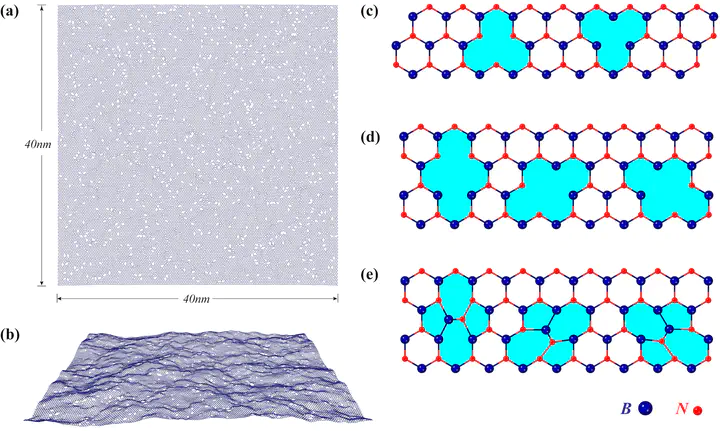
Through extensive molecular dynamics simulations, we completed the thermal transport properties study of the monolayer hexagonal boron nitride (h-BN) films from the defect state to the amorphous state. To this end, a defective h-BN model construction program has been developed, which can customize the nature of the defects and realize the transition from the defect state to the amorphous state. By performing homogeneous nonequilibrium molecular dynamics simulations based on Tersoff multi-body potential, the thermal conductivity results of large-size h-BN films have been achieved. For the defect state h-BN, we studied the effect of different defect types and concentrations on its thermal conductivity and verified it from the phonon mechanism. After the transition to two-dimensional amorphous BN, we discussed and analyzed the influence of amorphous concentration, amorphous defect ratio and temperature on its thermal transport properties. On this basis, the restriction relationship between phonon-phonon scattering term and phonon-defect scattering term was also proposed from the atomic level mechanisms. Our results constitute a step in the deterministic engineering of thermal management devices in 2D materials, and hold great promise for the application of h-BN defect engineering in the field of nanomaterial thermal design.

Xin Wu (武鑫)
PhD candidate of Solid Mechanics
My research interests include thermal transport in nanomaterials, molecular dynamics, and machine learning.